Identifying Common Backyard Birds in Winter
Winter transforms the backyard landscape, bringing a different cast of bird species to feeders and gardens. For those who enjoy observing wildlife through the colder months, learning to identify the most frequent visitors can enhance the experience. Several small bird species remain active throughout winter, relying on feeders and natural food sources to survive. Among them, chickadees, finches, and sparrows are among the most commonly seen. Understanding their key physical traits, behaviors, and vocalizations can help distinguish one from another, even when they appear similar at first glance.
This article provides an overview of the field marks and habits that characterize these winter residents. By paying attention to size, plumage patterns, bill shape, and feeding styles, observers can develop a more systematic approach to identification. The information presented here is intended to support personal observation and learning, not to replace guidance from experienced naturalists or ornithological resources. Each species has its own seasonal variations, and individual birds may differ slightly from standard descriptions.
Chickadees: Small, Active, and Curious
Chickadees are among the most recognizable winter backyard birds in many parts of the United States. In the northern and eastern regions, the Black-capped Chickadee is especially common, while in the southeastern states the Carolina Chickadee takes its place. Both species share a similar appearance: a black cap and bib, white cheeks, and a grayish body with a lighter underside. Their small size, often around five inches in length, and their constant movement make them easy to spot. Chickadees frequently hang upside down on branches while foraging for insects or seeds.
One useful identification clue is the color of the sides. Black-capped Chickadees tend to have more buff or warm-toned flanks, whereas Carolina Chickadees show grayer flanks. The calls also differ—the familiar “chick-a-dee-dee” of the Black-capped has a more drawn-out note pattern, while the Carolina’s version is faster and higher-pitched. During winter, chickadees often join mixed-species flocks with nuthatches, titmice, and woodpeckers. Observers can look for these flocks as a sign that chickadees are nearby. At feeders, they prefer sunflower seeds and suet, and they are known for taking one seed at a time and flying away to eat it.
Finches: Seed-Eating Specialists with Distinctive Bills
Finches are another group of winter feeder visitors that bring variety to the backyard. The House Finch is widespread across the country, with males displaying a reddish head and breast, while females are streaked brown and gray. The American Goldfinch, which is bright yellow in summer, molts into a duller olive-brown plumage in winter, often causing confusion with other finches. Pine Siskins are smaller, heavily streaked finches that sometimes irrupt southward in large numbers during winters with poor cone crops in the north.
The most reliable field mark for finches is their conical bill, which is adapted for cracking seeds. House Finches have a relatively thick, curved bill; American Goldfinches have a smaller, more pointed bill; and Pine Siskins have a slender, sharply pointed bill. Behavior also differs: goldfinches often feed in flocks and are acrobatic at nyjer seed feeders, while house finches are more likely to perch on tray feeders. The songs and calls are distinct as well—house finches have a long, warbling song, while goldfinches give a series of “per-chick-o-ree” calls in flight. Paying attention to these details can help distinguish finches even when their colors are subdued in winter.
Sparrows: Subtle Patterns and Ground-Feeding Habits
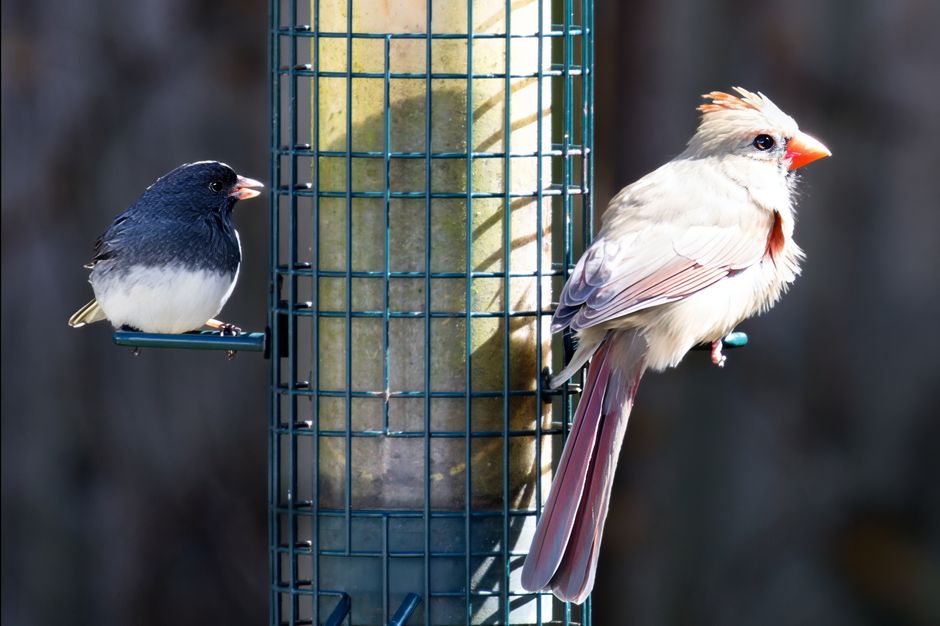
Sparrows can present a greater identification challenge due to their often subtle plumage patterns. Several sparrow species spend the winter in backyards across the United States, including the House Sparrow, White-throated Sparrow, Song Sparrow, and Dark-eyed Junco (which is actually a sparrow relative). House Sparrows are stocky, with males having a gray crown, black bib, and chestnut nape; females are plain brown and gray. White-throated Sparrows have a crisp white throat, a yellow spot between the eye and bill, and bold black-and-white head stripes. Song Sparrows show heavy streaking on the breast that often converges into a central spot. Dark-eyed Juncos are slate gray above and white below, with white outer tail feathers.
Key identification strategies for sparrows include observing the head pattern, the presence and shape of streaks on the breast and flanks, bill shape, and tail behavior. Many sparrows feed on the ground, scratching for seeds under feeders or in leaf litter. Their flight patterns are typically short and fluttering. Vocalizations can be helpful: the White-throated Sparrow’s whistled song (“Oh, sweet Canada, Canada, Canada”) is a distinctive winter sound in many regions. Song Sparrows have a complex, varied song, while House Sparrows produce a simple cheeping call. Because sparrows often stay low and in dense vegetation, patience and careful scrutiny are needed to identify them correctly.
Other Notable Winter Visitors to Feeders
Beyond chickadees, finches, and sparrows, several other species frequently appear at winter feeders. Nuthatches, such as the White-breasted and Red-breasted, are known for moving headfirst down tree trunks and branches. They have a long, pointed bill and a habit of storing seeds in bark crevices. Cardinals, especially the bright red males, are striking visitors in the eastern and central United States; they are large, crested, and have a thick orange-red bill. Downy and Hairy Woodpeckers may come to suet feeders, and their size difference and bill length are key distinguishing features. Blue Jays are large, noisy, and often dominate feeders, but their blue and white plumage is unmistakable.
Winter finches such as Common Redpolls and Evening Grosbeaks may appear irregularly depending on food availability farther north. Observers should note the time of year, geographic location, and local habitat to anticipate which species are likely. Keeping a simple journal of sightings can help track patterns over multiple winters. Resources such as regional field guides, birding apps, and local bird clubs offer additional support for confirming identifications.
Tips for Systematic Identification at the Feeder
Developing a reliable identification process involves more than memorizing field marks. One method is to start by noting the overall size and shape of the bird, then move to specific features: bill shape and color, head markings, breast pattern, wing bars, tail length, and leg color. Behavior also provides clues—does the bird cling to the feeder’s perch, or does it feed on the ground? Does it fly away quickly or linger? Does it come alone or in small flocks? Seasonal changes in plumage, especially among finches, can alter appearance, so it can be useful to consult references that show both breeding and non-breeding forms.
Photography can be a helpful tool, as images allow for later comparison with guides. Binoculars with good close focus capability make it easier to see details without disturbing the birds. Positioning feeders in a location with good natural light and a clear view from a window can improve observation quality. It may also be beneficial to provide a variety of foods—black oil sunflower seeds, nyjer, suet, and millet—to attract a wider range of species. Over time, consistent attention to these details builds familiarity and confidence in distinguishing even the most similar-looking winter visitors.